
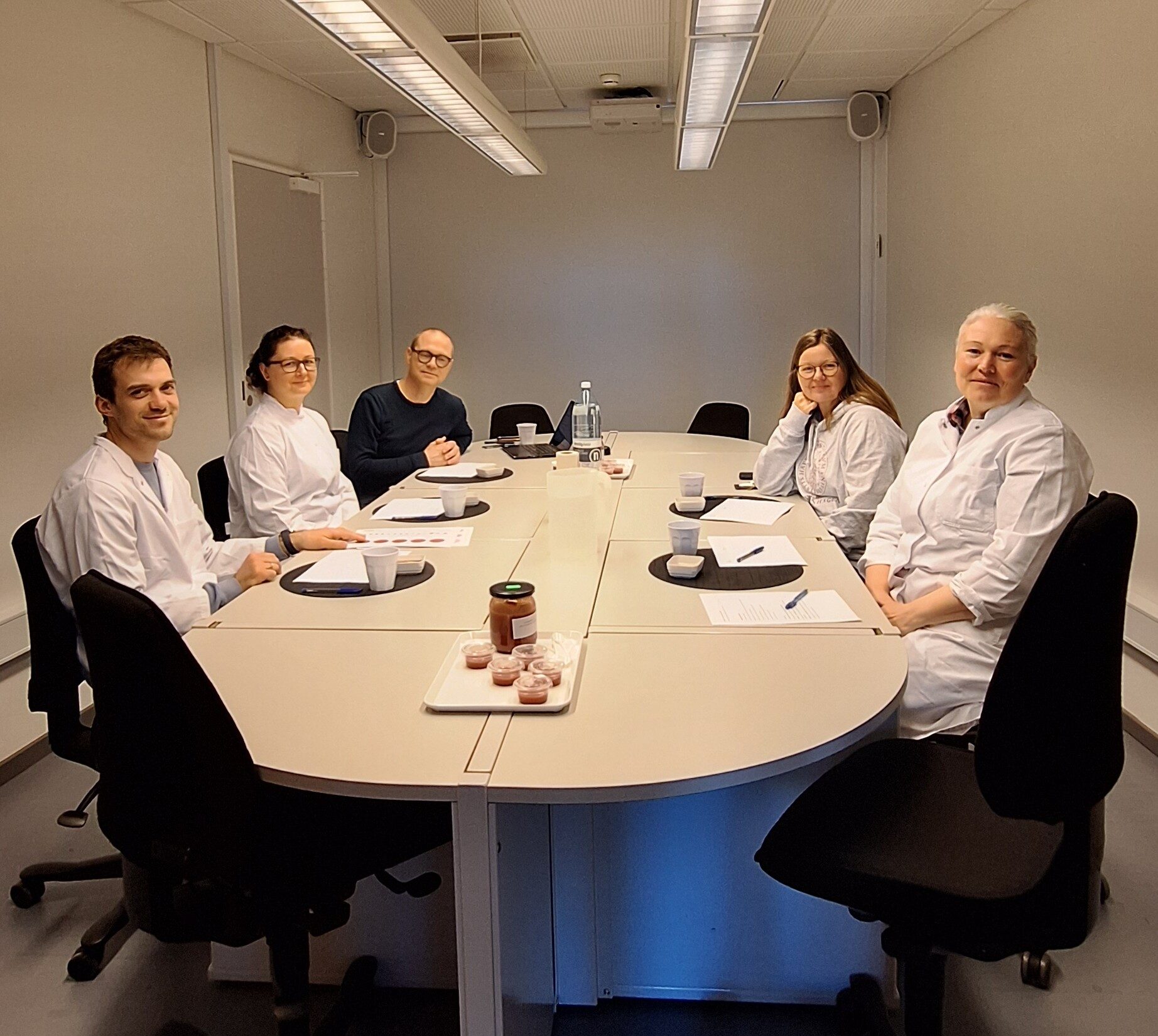
Two researchers from InHort, Karolina Celejewska and Jan Piecko, were in Copenhagen during the last two weeks (30.03–11.04.2025), where they took part in an internship led by experts from Copenhagen University: Michael Bom Frost, Belinda Lange, and Charlotte Dandanell. They were taught how to carry out sensory analysis, especially the descriptive method and projective mapping. The products for the assessment had been prepared at InHort. For the descriptive analysis, they used strawberry and haskap berry purées, either treated or untreated with ultrasound. For the projective mapping, some cranberries were experimentally dried, while others were commercial samples from the Polish and Danish markets.
They began with pretesting the purée and cranberry samples together with the experts to familiarize themselves with the products and discuss the research questions and product characteristics/possible variables.
A roundtable session with six panellists took place in a sensory evaluation room. Samples were presented one by one, and the panellists discussed in pairs, describing their impressions of appearance, smell, texture, taste, mouthfeel, and aftertaste. Haskap berry was a completely new fruit for them, so they had to get acquainted with it. Afterward, they discussed with the panel leaders which variables to select. It was decided to use 29 attributes for the next stage of assessor training. Together with an expert, they created a preliminary assessment form in the Fizz Programme.
Karolina and Janek prepared standards for specific attributes, and the initial panel training was conducted using those standards. Among others, beetroot was used as a standard for earthy smell and taste, green strawberries for unripe flavor, and water solutions of sucrose, citric acid, and caffeine for the basic tastes of sweet, sour, and bitter. Following this, an assessment was conducted in sensory booths with three pairs of purée samples to test how well the panellists could use the scale and relate their perceptions to the presented standards.
In the meantime, there was a discussion about Danish cranberry samples from the market to be used for projective mapping. Out of eight different cranberry samples, three were eventually selected for the assessment.
The final assessment from the panel training phase was conducted with another three pairs of purée samples, this time presenting only the standards that the panellists had struggled with the most.
After the first week, the panel was ready for the final sensory analysis, which was carried out on Tuesday and Wednesday of the second week in three replicates. On Wednesday, the projective mapping was also conducted. The researchers, together with the experts, calculated the results, discussed them, and summarized the training.