
Researchers from the National Institute of Horticultural Research (InHort) in Skierniewice, Anna Wrzodak and Dawid Wieloch, completed a scientific internship at the University of Copenhagen from May 19 to May 30, 2025.
The internship was conducted under the supervision of experts in the field of sensory food analysis: Michael Bom Frøst, Belinda Lange, and Charlotta Dandanell.
The objective of the training was to deepen the knowledge and practical skills of InHort staff regarding sensory evaluation of food products and the methodologies used to describe them. The research focused on innovative aronia-based products developed at InHort. Using the descriptive sensory analysis method, Quantitative Descriptive Analysis (QDA), sensory evaluations were conducted on eight types of aronia-based coulis that varied primarily in flavor and aroma (e.g., mint, mango, and vanilla variants).
Additionally, the sensory method of projective mapping was applied to characterize nine innovative aronia-vegetable pastes enhanced with various flavoring components.
The aronia coulis developed by Anna and Dawid was a completely novel product for the sensory panel at the Copenhagen laboratory. As such, aligning and standardizing the sensory perceptions required several days of intensive training. Under the leadership of Belinda Lange, a ten-member sensory panel began by familiarizing themselves with the product, conducting initial evaluations of all samples, and establishing key sensory quality attributes related to aroma, taste, and texture. An evaluation form was created using the FIZZ sensory analysis software.
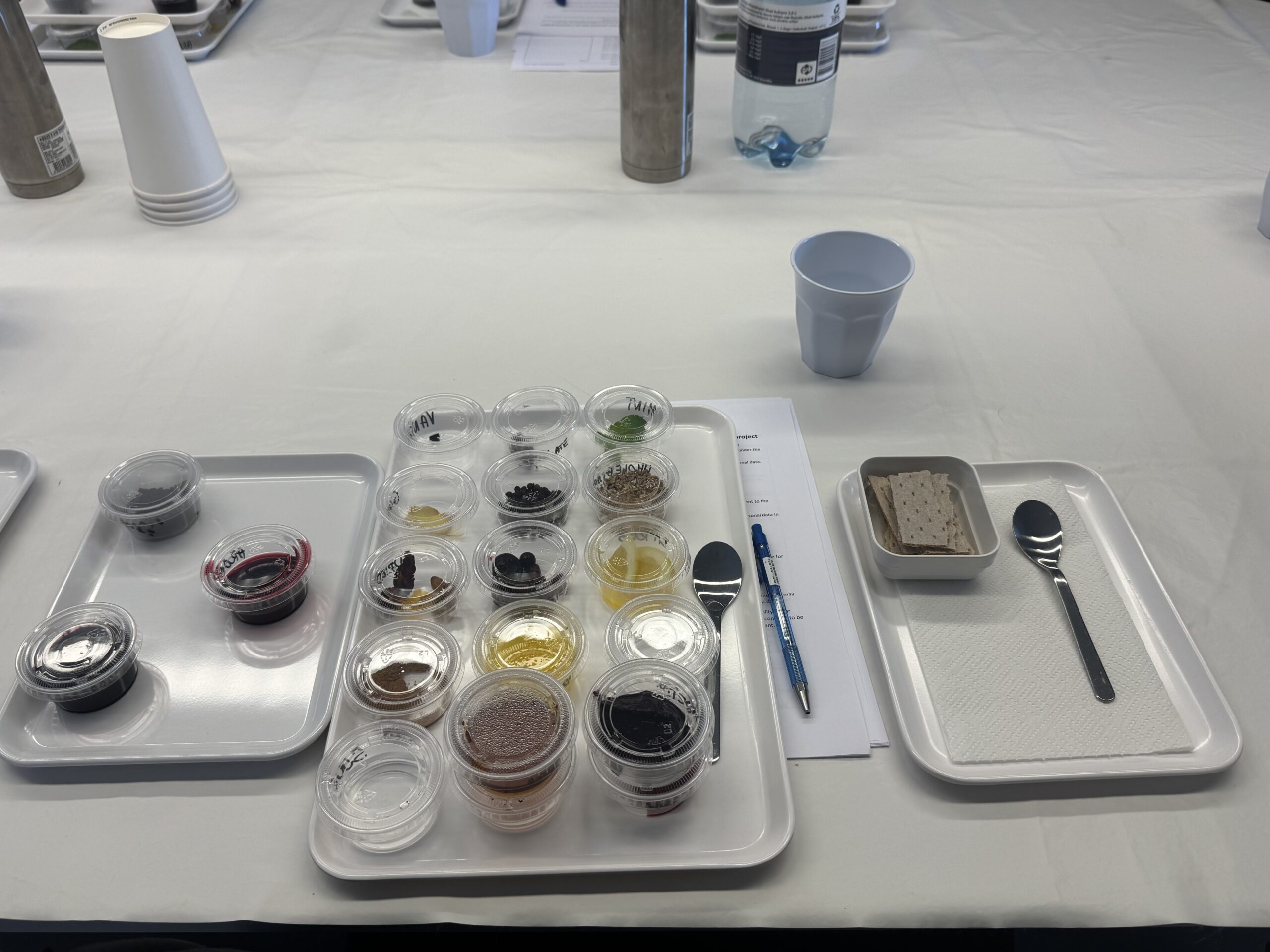
Anna and Dawid prepared 20 reference samples to define and calibrate the selected sensory attributes describing the aronia coulis. One noteworthy case involved a coulis sample with pistachio cream; interestingly, without knowing the formulation, the panelists described the flavor as „chocolate-like.” As a result, dark chocolate was introduced as a reference sample during subsequent training sessions.
Over the next three days, the sensory panel performed structured testing of the aronia coulis samples, culminating in a final sensory evaluation of the product.
Another innovative product developed using the projective mapping technique was a series of aronia-based pastes enriched with vegetables such as beetroot, pumpkin, and bell pepper. The sensory panel was briefed on the objectives and methodology of the task, which aimed to assess the sensory properties of the pastes and identify similarities and differences between samples.
The training in Copenhagen concluded with a comprehensive discussion of the results from the QDA analysis of the aronia coulis and aronia-vegetable pastes, conducted with Michael Bom Frøst.
The knowledge and experience gained at the University of Copenhagen will support Anna and Dawid in continuing their research and coordinating sensory analysis activities at InHort.